
If you have a $1,000 marketing budget for your junk removal business, you are standing at a critical fork in the road. An empty truck is a money pit—it means insurance, truck payments, and crew wages are draining your bank account while you wait for the phone to ring.
You need boots on driveways, and you need them now.
To get your phone ringing, you have two primary options: PPC (Pay-Per-Click ads) or SEO (Search Engine Optimization). Both claim to be the best way to get jobs, but when you only have $1,000 to drop, they behave very differently.
Let’s break down exactly where that first grand should go so you don’t watch it vanish into the internet space.
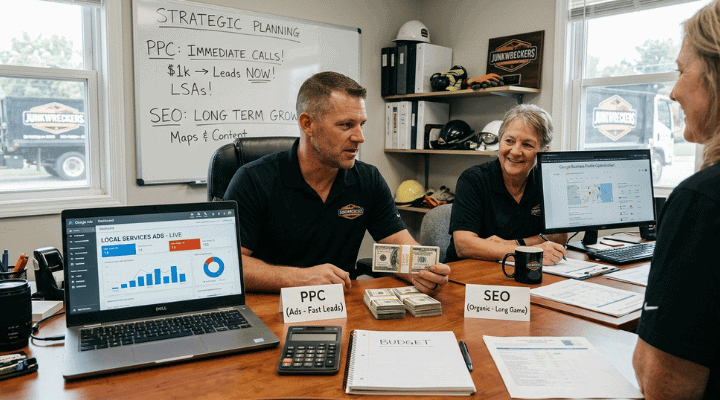
The Quick Definitions (Without the Tech Jargon)
Before pulling out the credit card, let’s look at what you are actually buying:
PPC (Google Ads / Local Services Ads): This is the “Fast Action” route. You pay Google every single time someone clicks your ad or calls your business from a search result. When you turn it on, you show up at the very top of the page instantly. When your $1,000 runs out, your ads disappear.
SEO (Optimizing your website and Google Map Pack): This is the “Long Game.” You spend money to fix up your website, build local city landing pages, and gather reviews so Google ranks you naturally. It takes months to start working, but once you rank at the top, every click and call is 100% free.
The $1,000 Reality Check
To make the right choice, you have to look at how far $1,000 actually goes in each strategy for a local hauling business.
| Feature | PPC (Paid Ads) | SEO (Organic Ranking) |
|---|---|---|
| Speed | 24 to 48 hours | 3 to 6 months |
| Cost per lead | $15 – $40 per phone call | Free (after setup labor) |
| What $1k buys | 25 to 50 high-intent leads | 1 or 2 high-quality local service pages |
| Longevity | Stops the second budget hits $0 | Lasts for months or years |
The Case for PPC: When You Need Jobs Tomorrow
If your schedule is empty and you need high-margin, full-truckload bookings immediately, PPC is the clear winner for your first $1,000.
Junk removal is a high-intent, emergency-style service. People don’t usually browse junk removal websites for fun or research them weeks in advance. They are standing in a garage full of old furniture, or they just finished a tenant cleanout, and they want the stuff gone today. They grab their phone, type in “junk removal near me,” and click the very first phone number they see.
With $1,000, you can bypass the line and put your phone number right at the top of Google.
Where to put the money: Do not just dump cash into standard Google Search ads where you pay for accidental clicks. Put it into Google Local Services Ads (LSAs). These are the ads that display the “Google Guaranteed” green checkmark. Best of all, you only pay when a customer actually calls or texts you through the ad, completely protecting your budget from wasted clicks.
The Case for SEO: When You Are Building an Asset
If you already have steady word-of-mouth clients, your trucks are mostly full, and you want to make sure you don’t have to keep paying Google for leads forever, SEO is where you invest.
Spending $1,000 on SEO won’t fill your calendar next Tuesday. Instead, it pays a developer or writer to optimize your Google Business Profile, fix your mobile website speed, and create custom landing pages for the neighborhoods you service.
It is the equivalent of buying a building instead of renting it. It takes time to build equity, but eventually, the asset pays for itself.
The Verdict: Where Should You Spend Your First $1,000?
Spend it on PPC.
When you are starting out or looking to scale a local home service business, cash flow is king. You cannot afford to spend $1,000 on an SEO campaign and wait four months to find out if it worked. You need to turn that $1,000 into $3,000 or $4,000 of booking revenue within the next 30 days.
Use PPC to get the phone ringing, fill your trucks, and stack up cash. Once those paid jobs start clearing a profit, take a portion of that new revenue and reinvest it into long-term local SEO and your Google Map Pack profile. That is how you dominate your local market for the long haul.