
In the junk removal business, an empty truck costs you money every single day. Your truck payment doesn’t stop. Insurance is still due. Your crew still expects a paycheck. Every empty spot on your schedule is lost revenue.
You don’t need more Facebook likes or “brand awareness.”
You need your phone to ring.
You need jobs booked.
You need your trucks pulling into driveways, not sitting in the parking lot.
Most marketing agencies will try to complicate this with fancy buzzwords and complex charts. But local service marketing boils down to two simple things:
- Getting in front of people who need junk hauled away right now.
- Reminding people who have clutter building up that they should pay you to deal with it today.
If your schedules are sporadic and you are relying entirely on low-margin single-item pickups from local classifieds, you need a system. This guide is your step-by-step, no-nonsense roadmap to dominating your local market using a multi-channel strategy. No fluff, no AI-generated theories. Just the exact blueprint to keep your trucks moving, your trailers full, and your phones ringing off the hook.
Google Ads: The High-Intent Cash Machine
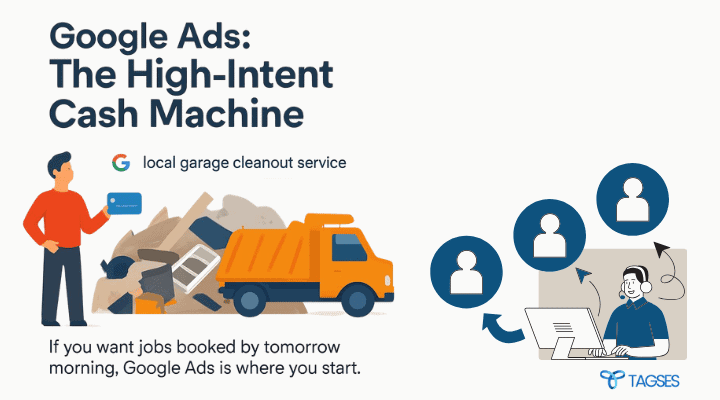
If you want jobs booked by tomorrow morning, Google Ads is where you start. When someone types “local garage cleanout service” or “construction debris hauling” into Google, they aren’t browsing. They are standing in a pile of mess with a credit card in their hand. They want a truck at their house today or tomorrow.
However, Google Ads is also the fastest way to burn cash if you don’t set it up right. Most owners set up a basic campaign, use Google’s default settings, and watch $1,000 disappear into useless clicks.
The Broad Match Trap
When you build your campaign, Google will push you to use Broad Match keywords. If you target the phrase junk removal as a broad match, Google will show your ad to anyone searching for anything vaguely related to those words.
Suddenly, you are paying $15 a click for people typing:
- “Where is the city dump?”
- “Free couch donation pickup”
- “Junk removal helper jobs near me”
You just paid for someone else’s job hunt or a DIYer trying to find a free recycling center.
How to Fix It: Phrase and Exact Match
You must tell Google exactly who you want to pay for. Shift your strategy to Phrase Match and Exact Match.
- Phrase Match (
"..."): Wrapping your keyword in quotes, like"junk removal company", tells Google your ad should only show if their search includes that specific phrase. It filters out the vast majority of junk traffic. - Exact Match (
[...]): Putting brackets around your keyword, like[mattress removal service], means the user must type those exact words. These clicks cost a bit more, but they convert into booked jobs at an incredibly high rate.
Your Defensive Shield: Negative Keywords
A negative keyword list tells Google: “If the user includes this word in their search, do NOT show my ad.” This single step can instantly save you 30% to 50% of your daily ad budget.
Before you spend another dime, go into your Google Ads account and add these as negative keywords:
free,cheap,donation,Goodwill,Salvation Army,dump hours,DIY,how to,rent a truck,careers,salary.
Local SEO & The Google Map Pack
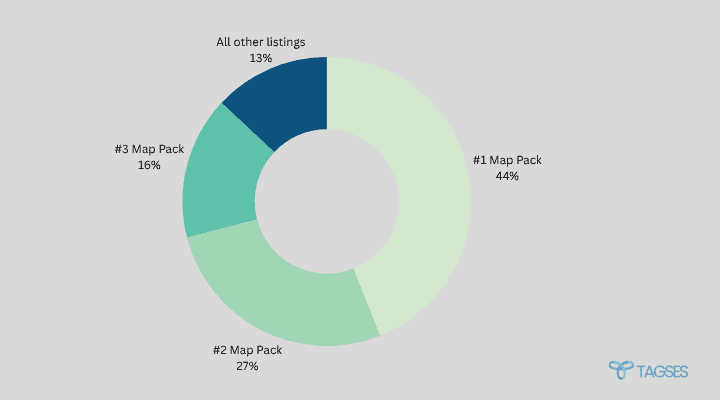
While Google Ads gets you jobs today, Search Engine Optimization (SEO) is how you secure free, consistent leads for the next five years. When someone searches for a local service, Google shows three local businesses right below the map. This is the Google Map Pack, and it is the most valuable digital real estate in your city.
If you aren’t in the top three map listings for your area, you are giving away hundreds of thousands of dollars in revenue to your competitors every single year.
Optimizing Your Google Business Profile (GBP)
Getting into the Map Pack isn’t random luck. It’s about sending the right signals to Google.
Claim and Verify Your Profile: Make sure your business name matches your real, legal name. Do not stuff it with fake keywords like “Fawad’s Junk Removal – Cheap Trash Hauling Cleanout Service” or Google will eventually suspend your listing.
Choose the Right Primary Category: Your primary category must be “Junk Removal Service”. You can add secondary categories like “Waste Management Service” or “Demolition Contractor,” but the primary one dictates what you rank for.
Fill Out Every Inch: Add your exact service areas by zip code or city name. Add your hours, your phone number, and a link to your landing page.
Post Photos Weekly: Google loves active profiles. Upload raw phone photos of your trucks, your team in uniform, and the junk piles you’ve hauled away. Geotags and timestamps are automatically embedded in your phone’s photos, telling Google exactly where you operate.
Reviews: The Ultimate Trust Currency

You can have the best website in the world, but if your competitor has 150 five-star reviews and you only have four, the customer is going to call them every single time. In a local service business, trust is everything. Homeowners are letting strangers into their backyards, basements, and around their families. They want proof that you are polite, careful, and honest.
Build a Review System
Hoping customers leave a review out of the goodness of their hearts doesn’t work. You need a systematic way to ask for them on every single job.
The In-Person Hand-Off: The best time to get a review is right when the job is done, the floor is swept, and the customer is standing there amazed by their clean space. Have your crew say: “Hey Mrs. Jones, we really appreciate your business today. Our team gets a small bonus for every 5-star review we receive. Would you mind tapping this link to share your experience?”
The QR Code Card: Print out simple business cards with a QR code that links directly to your Google review page. Hand it to the client with the final invoice.
Automated Text Follow-Up: Within an hour of completing the job, send an automated text message: *”Hey [Name], thanks for choosing us today! If you’re happy with your clean space, could you take 30 seconds to leave us a review? It helps our small business a ton: [Link]”
Facebook Ads: Interrupting the Clutter
As we discussed earlier, Facebook Ads are a completely different animal than Google. On Google, people are hunting for you. On Facebook, you are hunting for them.
You are disrupting their casual scrolling with an offer they can’t ignore. Nearly every homeowner has a project they are putting off. Your ad needs to be the spark that finally makes them take action.
The Content Structure That Converts
Don’t use corporate graphics or stock photos of models smiling next to a pristine trash bin. It looks fake and people skip right past it. Use raw, real, high-contrast imagery.
Before/After Sliders: Show a heavily cluttered environment next to a perfectly clean, empty room.
The “What We Take” List: Keep your ad copy extremely clear. List out common headaches: Mattresses, Old Appliances, Yard Waste, Estate Cleanouts, Construction Debris.
Clear Pricing Expectations: You don’t have to give an exact quote on the ad, but letting them know you offer free, no-obligation, on-site estimates removes the barrier to entry.
The Targeted Approach
Never target an entire state or broad demographic. Focus purely on geography and homeownership. Filter your audience to a strict radius around your trucks, targeting people aged 30–65 who are listed as homeowners. This ensures your budget isn’t being spent on renters who don’t have the authority to clear out a garage or dispose of major appliances.
Website Optimization: Built to Make the Phone Ring
Driving traffic to your website via SEO and paid ads is only half the battle. If your website is confusing, slow, or looks like it was built in 2005, those visitors will immediately leave and look for someone else.
Your website doesn’t need to be an artistic masterpiece. It is an online cash register. Its only job is to turn a visitor into a phone call or a form submission.
Build Service-Specific Landing Pages
If someone clicks an ad searching specifically for “hot tub removal,” do not send them to your generic homepage where they have to hunt through menus to see if you handle hot tubs.
Create dedicated sub-pages for your core services:
[yourwebsite.com/mattress-removal](https://yourwebsite.com/mattress-removal)[yourwebsite.com/estate-cleanouts](https://yourwebsite.com/estate-cleanouts)[yourwebsite.com/construction-debris](https://yourwebsite.com/construction-debris)
When the landing page matches the exact intent of the user’s search, your conversion rates will skyrocket.
Follow-Up Systems: Stop Letting Gold Slip Through the Cracks

You can execute every step of this guide perfectly, but if you have a slow or broken follow-up system, you are lighting your marketing budget on fire.
Junk removal is an incredibly fast, transactional industry. If a customer fills out a quote form on your website and you take two hours to call them back, they have already scrolled down to the next business on Google, called them, and booked a time slot. You paid for their visit to your site, but your competitor got the actual cash.
he 5-Minute Rule
You must treat every incoming online lead like an absolute emergency. If an online quote form hits your inbox, you or your office coordinator need to call or text that lead within 5 minutes.
Implement an automated text messaging system. The second a form is submitted, the system should send an instant text back to the customer:
“Hey [Name]! This is Fawad from the team. I received your request for a junk estimate. If you can reply with a quick photo of the items you need hauled away, I can give you an estimate right now!”*
This immediately stops them from continuing to shop around because they are actively engaged in a conversation with you.
Database Reactivation: The Hidden Revenue
Most junk removal companies focus entirely on finding new customers. But your most valuable asset is your existing customer database.
People who used you last year to clear out their basement likely have a pile of yard waste or old furniture building up again this year. They already know you, trust you, and have your team in their house.
Twice a year (ideally during the spring cleaning rush and late autumn), send a mass broadcast text or email to your past customer list:
“Hey [Name], it’s Fawad. We’re running our neighborhood clear-out specials this week. Since you’ve worked with us before, we’d love to offer you $25 off your next full truckload if you need anything hauled away before summer hits. Text us a photo of your pile to lock in your discount!”
This simple strategy costs almost nothing to execute and can easily fill your schedule for a week or two during sluggish seasons.
Bringing It All Together: Your Weekly Routine
Domination doesn’t happen by accident. It is the result of consistently executing these core principles week in and week out.
To scale your junk removal business efficiently, focus on this simple operational routine:
Every Day: Answer every phone call by the second ring. Follow up on online form leads within 5 minutes.
Every Job: Take high-quality before/after photos. Ask the customer directly for a Google review before your truck leaves their driveway.
Every Week: Upload fresh photos to your Google Business Profile. Review your Google Ads account to add new negative keywords and cut out wasted search traffic.
Every Season: Update your Facebook ad creative to match what homeowners are currently stressing about (spring cleaning, moving season, storm debris, holiday clutter).
Stop chasing vanity metrics, stop buying useless “clicks,” and focus entirely on building a highly optimized, fast-responding pipeline that turns local search intent into boots on driveways and cash in your bank account.